

Dr. Elisabeth Kübler-Ross: A Legacy of Compassion, Courage and Transformation
Elisabeth Kübler-Ross was born on juillet 8, 1926, in Zurich, Switzerland, one of triplet sisters. Fiercely independent from childhood, she set her sights on medicine against her father’s wishes and entered the University of Zurich, where she met her future husband, the American medical student Emanuel “Manny” Ross.
Sa vocation a pris forme au lendemain de la Seconde Guerre mondiale. En 1945, à l’âge de dix-neuf ans, elle s’est engagée comme volontaire au sein du Service international des volontaires pour la paix, contribuant à la reconstruction de communautés dévastées en Europe de l’Est. Au camp de concentration de Majdanek, en Pologne, elle a découvert des papillons gravés sur les murs des baraquements des enfants — derniers messages d’espoir laissés dans un lieu d’horreur. Cette image l’a marquée pour le reste de sa vie, et le papillon est devenu son symbole de transformation.
Elle a obtenu son diplôme de médecine en 1957 et s’est installée aux États-Unis en 1958, où elle a travaillé dans des hôpitaux à New York, dans le Colorado, puis à Chicago. C’est là qu’elle a constaté à quel point les patients en fin de vie étaient laissés seuls — physiquement et émotionnellement — par des médecins qui les évitaient, un personnel qui gardait ses distances et des familles qui ne savaient pas quoi dire. « Personne n’était honnête avec eux », a-t-elle déclaré, « alors je me suis donné pour mission de les écouter. » S’asseoir aux côtés des patients en fin de vie et les laisser s’exprimer, souvent en présence d’étudiants en médecine et de membres du clergé, est devenu le fondement de tout ce qui a suivi.
In 1969 she published On Death and Dying, drawn from those interviews. In it she described five responses she had observed in patients facing a terminal diagnosis — denial, anger, bargaining, depression and acceptance. She was clear that these were not a fixed sequence, that not everyone experiences all of them, and that they can overlap and return. Her point was never a formula; it was that dying people have wisdom to share and deserve to be heard. The book became an international bestseller, was featured in Life magazine, and is still taught in medical, nursing and counseling programs around the world. In 1999 the New York Public Library named it one of its Books of the Century.
The “five stages” later took on a life of their own, applied to grief of every kind and often reduced to a checklist she never intended. In her last book, On Grief and Grieving (2005, with David Kessler), she wrote that the stages “were never meant to help tuck messy emotions into neat packages.” The Elisabeth Kübler-Ross Foundation presents her work in that spirit — as an invitation to listen, not a map to follow.
Son influence fut rapide et de grande envergure. En 1972, elle témoigna devant le Sénat américain sur la prise en charge des personnes en fin de vie dans les hôpitaux américains, une tribune rare pour une femme médecin d’origine étrangère, et son témoignage contribua à ouvrir la voie aux mouvements en faveur des soins palliatifs et des hospices aux États-Unis. Tout au long des années 1970, elle a donné chaque semaine des conférences devant des milliers de personnes, partageant la tribune avec des personnalités telles que Ram Dass et le Dr William Worden, spécialiste du deuil, et a contribué à faire évoluer le débat public sur la mort, pour qu’elle soit considérée non plus comme un événement clinique, mais comme une expérience humaine.
Elle a travaillé aux côtés du Dr Balfour Mount, fondateur des soins palliatifs en Amérique du Nord, dont l’unité à l’Hôpital Royal Victoria de Montréal s’est inspirée de son enseignement. Elle s’est faite la championne des soins palliatifs pour les enfants à une époque où cette idée était encore taboue, effectuant le premier don à l’association Children’s Hospice International, fondée par Ann Armstrong-Dailey. Et à partir de 1984, à Vacaville, en Californie, puis en Irlande et en Écosse, elle a introduit les soins palliatifs dans les prisons — un travail qui a jeté les bases des programmes de soins palliatifs en milieu carcéral tels qu’on les connaît aujourd’hui.
En 1977, elle a fondé Shanti Nilaya (« la maison de la paix ») à Escondido, en Californie, un centre de retraite et d’enseignement, d’où sont nés ses ateliers sur « la vie, la mort et la transition », qui se poursuivent encore aujourd’hui. En 1985, elle s’installa dans une ferme à Head Waters, en Virginie, qu’elle baptisa « Healing Waters », avec l’intention d’ouvrir un centre de soins palliatifs pour les bébés atteints du sida et abandonnés par leurs familles. Ce projet se heurta à une farouche opposition locale, et en 1994, sa maison fut entièrement détruite par un incendie criminel. Elle perdit ses archives, ses écrits et la quasi-totalité de ses biens. Elle subit ensuite une série d’AVC qui la laissèrent partiellement paralysée.
She spent her last years in Scottsdale, Arizona, near her son Ken. The strokes left her partly paralyzed, and she was frank about how hard that was. But her own letters from those years tell a different story from the one often repeated. In 1998 she completed her fourth 10-kilometer benefit walkathon in Phoenix, in her wheelchair, and gave her first public talks in four years. She fed some 200 birds and 14 coyotes outside her living-room window, and joked that her water therapy let her walk in water, “if not on water.” Comparing herself with patients far sicker than she was, she called herself lucky. She finished Life Lessons with David Kessler, her first book, she said, about life rather than death. In 2001 she flew to Maine to accept a lifetime achievement award for her hospice work, and Meilen, the lakeside town where she grew up, made her an honorary citizen. She continued to write, teach and receive visitors, among them Muhammad Ali, Oprah Winfrey, Susan Sarandon and Shirley MacLaine. Her letters from these years are collected in the Foundation’s Newsletters Archive.
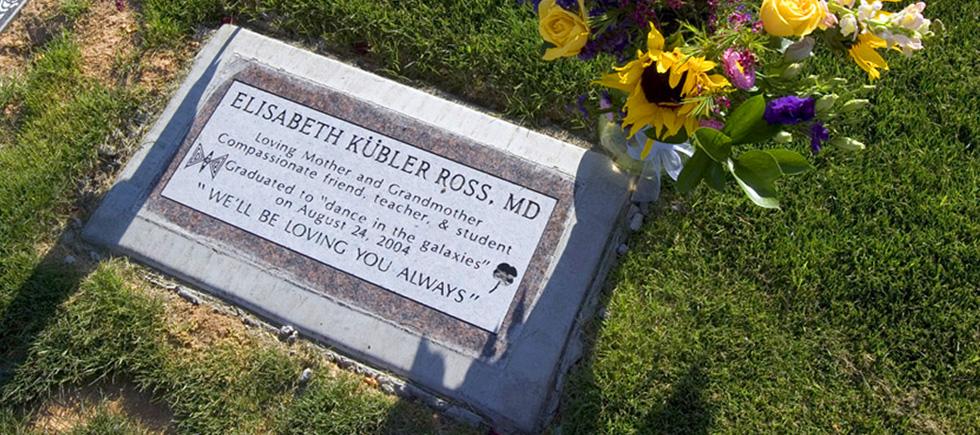
She died on août 24, 2004, at the age of 78. Elisabeth Kübler-Ross wrote 24 books, published in 44 languages, including Questions and Answers on Death and Dying, On Children and Death, The Wheel of Life and Life Lessons (with David Kessler). She received 19 honorary degrees, was a founding member of the American Holistic Medical Association, co-founded the International Work Group on Death, Dying and Bereavement, and was named Ladies’ Home Journal Woman of the Decade in 1979. In 1999 TIME magazine profiled her as one of the “unsung heroes” of twentieth-century science and medicine in its TIME 100 Scientists and Thinkers issue. She was inducted into the National Women’s Hall of Fame in 2007.
Her ideas have traveled far beyond medicine. The Kübler-Ross Change Curve®, adapted from her work, is used by organizations worldwide to help people through change. The five stages have become part of everyday language, from television and literature to more than 200 recording artists who have named albums, songs, and bands after them, usually in the short, ordered form she spent years qualifying. That reach is one reason the Foundation works to present the stages as she actually wrote them.
2026 marks the centennial of her birth. To mark it, the Elisabeth Kübler-Ross Foundation is bringing her original teachings to new audiences: a restored and updated edition of On Death and Dying, her archival lectures and interviews made available in English, German and Spanish, new education programs developed with partner organizations in hospice and end-of-life care, and the continued work of the Foundation’s international chapters — from a hospice under construction in the villages of eastern Guatemala to pediatric hospice in Chile.
Elle enseignait que la mort n’est pas un ennemi, mais un maître, et que la manière dont nous prenons soin des mourants est la mesure de l’attention que nous portons les uns aux autres. Le papillon qu’elle avait rapporté de Majdanek reste le symbole de la Fondation : dans la mort, comme dans la vie, il y a transformation, sens et espoir.