

On Death and Dying
What the Dying Have to Teach Doctors, Nurses, Clergy and Their Own Families — Elisabeth Kübler-Ross, 1969
Few books have changed how the world treats the dying as much as this one. It is also one of the most misread. Most people know it as the source of the “five stages.” Far fewer have read what is actually in it: the voices of dying patients, speaking for themselves at a time when almost no one would speak to them.

A book that began with a question
In the fall of 1965, four students from the Chicago Theological Seminary asked Elisabeth to help them study dying. She proposed what no one was doing: ask the dying. Week after week, a seriously ill patient sat with her and spoke about what was happening to them, while students, chaplains, nurses and doctors listened, then discussed what they had heard.
The book grew from those conversations. Its subtitle says who the teachers were: not the doctors, but the patients. A University of Chicago colleague who watched her work for five years later called her the finest interviewer he saw in more than half a century of practice.
Dr. Kübler-Ross was an interviewing genius.
Mark Siegler, M.D., University of Chicago, in The American Journal of Bioethics (2019)
What is actually in the book
Most of On Death and Dying is not theory. It is conversation: long, carefully recorded interviews in which patients describe their fears, their anger, their bargains, their hopes and their loneliness. Elisabeth said plainly, in her preface, what the book was not.
It is not meant to be a textbook on how to manage dying patients, nor is it intended as a complete study of the psychology of the dying.
Elisabeth Kübler-Ross, On Death and Dying (1969), preface
Read the book itself and several things surprise people who know only the summary:
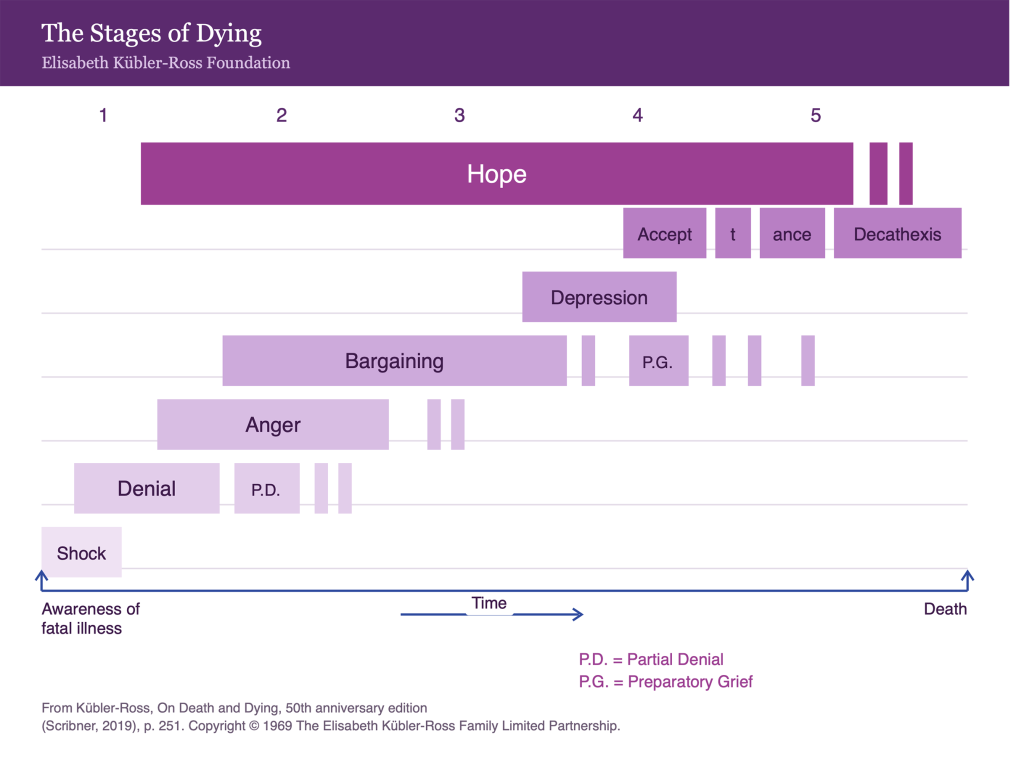
- The responses were never a staircase. She wrote that they “will last for different periods of time and will replace each other or exist at times side by side.”
- Hope runs through all of it. She gave hope its own chapter, and on her chart it is the longest line of all, from diagnosis almost to the end.
- Depression came in two kinds: a reactive grief over what has already been lost, and a preparatory grief for what is coming, each to be met differently.
- The family grieves too. A whole chapter shows relatives moving through the same anger and the same preparatory grief as the patient, in 1969, long before anyone spoke of “stages of grief.”
For how the stages developed after the book, from 1969 to 1980, see our Five Stages of Grief® page.
“Stages” in English, Phasen in German
Elisabeth was Swiss, and English was not her first language. “Stage” can suggest a staircase: one step, then the next, never back. German has to choose a word, and the choice matters. Since the first German edition, Interviews mit Sterbenden (1971), the book has used Phasen, phases that can overlap and return, and never Stadien, fixed steps in a sequence.
A phase is weather; a stage is a staircase. Much of the fifty-year argument over whether grief comes in “stages” turns on a single English word. The chart at the back of the book shows what she meant: ten responses in all, overlapping rather than in line, with hope running through every one. Only five were numbered.
The second book: Questions and Answers on Death and Dying (1974)
Five years later, Elisabeth answered the questions readers and professionals kept asking her. Many wanted to know whether what she had described applied to people who were not dying at all. Her answer was yes. Asked about a woman losing her sight, she said that her blind patients went through the same responses as her dying patients:
the same stages as anyone else who is in the process of losing something very important.
Elisabeth Kübler-Ross, Questions and Answers on Death and Dying (1974)
She said the same of paralyzed patients, many of them young Vietnam veterans. None of them was dying. By 1974, what began as a description of dying had become a description of loss, and loss belongs to the living.
What the book changed
Before 1969, dying patients were often not told they were dying, and hospitals kept them at the far end of the hall. On Death and Dying put their voices at the center. It is widely credited with helping to launch the hospice movement and palliative care, and with changing how doctors talk with seriously ill people.
In 2019, for the book’s 50th anniversary, The American Journal of Bioethics devoted an issue largely to it. Its lead article, by clinical ethicist Mark Kuczewski, argues that the book laid the foundation for clinical ethics consultation, and names three tensions it reveals that every ethicist must navigate but never fully resolve: hearing the patient’s voice versus medicalizing the case, helping toward a better death versus respecting how a patient wishes to die, and keeping professional distance versus truly engaging. He notes that many colleagues dismiss the book as “dated” without having read it.
the original bioethicist of the people
Mark G. Kuczewski, The American Journal of Bioethics (2019), on Elisabeth Kübler-Ross
Another contributor, the bioethicist Christoph Rehmann-Sutter, argues that later research finding variation in how people respond to loss is “not an argument contra Kübler-Ross,” but an answer to her invitation to listen more closely to patients. Read about the full issue.
From Dr. Ira Byock’s foreword to the current edition
“In a period in which medical professionals spoke of advanced illness only in euphemisms or oblique whispered comments, here was a doctor who actually talked with people about their illness and, more radically still, carefully listened to what they had to say.”
“Popularized as Kübler-Ross’s ‘stages of dying,’ they have been criticized for suggesting a formulaic progression of phases through the dying process. Anyone reading the book will recognize this characterization as a simplistic and inaccurate representation of what she described.”
“Things would never be the same. And we are all better for it.”
Ira Byock, M.D., Professor of Medicine, Geisel School of Medicine at Dartmouth, August 16, 2013. Excerpt courtesy of Dr. Ira Byock.
Still read, fifty-seven years on
On Death and Dying has never gone out of print. It is published in 42 languages, was named one of the New York Public Library’s Books of the Century, and in 2024 was chosen for the Simon & Schuster 100, the publisher’s selection of 100 books from its first century. In January 2026 it was the subject of a 41-minute documentary on Japan’s national broadcaster, NHK.
Read the book with us
The Foundation’s online course walks through On Death and Dying chapter by chapter, in Elisabeth’s own words, including how her thinking about the stages developed after the book. Self-paced, available worldwide.
Take the course
The Five Stages of Grief®
Bioethics Remembers Elisabeth
Quotations from Elisabeth Kübler-Ross © Elisabeth Kübler-Ross Family Limited Partnership. Used by permission. Five Stages of Grief® is a registered trademark of the Elisabeth Kübler-Ross Family Limited Partnership.