

Most people know Dr. Elisabeth Kübler-Ross for five stages. Far fewer know that, in her own work, the response to loss that mattered most was not one of the five at all. It was hope.
She drew it running beneath every other response. She gave it its own chapter. She kept it when she revised the model and let other parts go. And when she finally drew the stages without any order at all, she placed all of them inside a ring of hope.
The chapter no one mentions
In On Death and Dying (1969), the five chapters on denial and isolation, anger, bargaining, depression and acceptance are followed by a chapter titled simply "Hope."
Almost every summary of the book stops at acceptance. Elisabeth did not. After describing the five stages, she gave a whole chapter to the one thing she found persisting through all of them. Read in the order she wrote it, her account of the stages does not end with acceptance. It ends with hope.
Hope was never numbered
On the chart at the back of the book, ten responses appear as overlapping bands across a timeline, from the first awareness of a fatal illness to death. Only five of them are numbered. Hope has no number. It is the one band that runs the full length of the chart, present from the first news to the very end, alongside shock, anger, depression and acceptance alike.
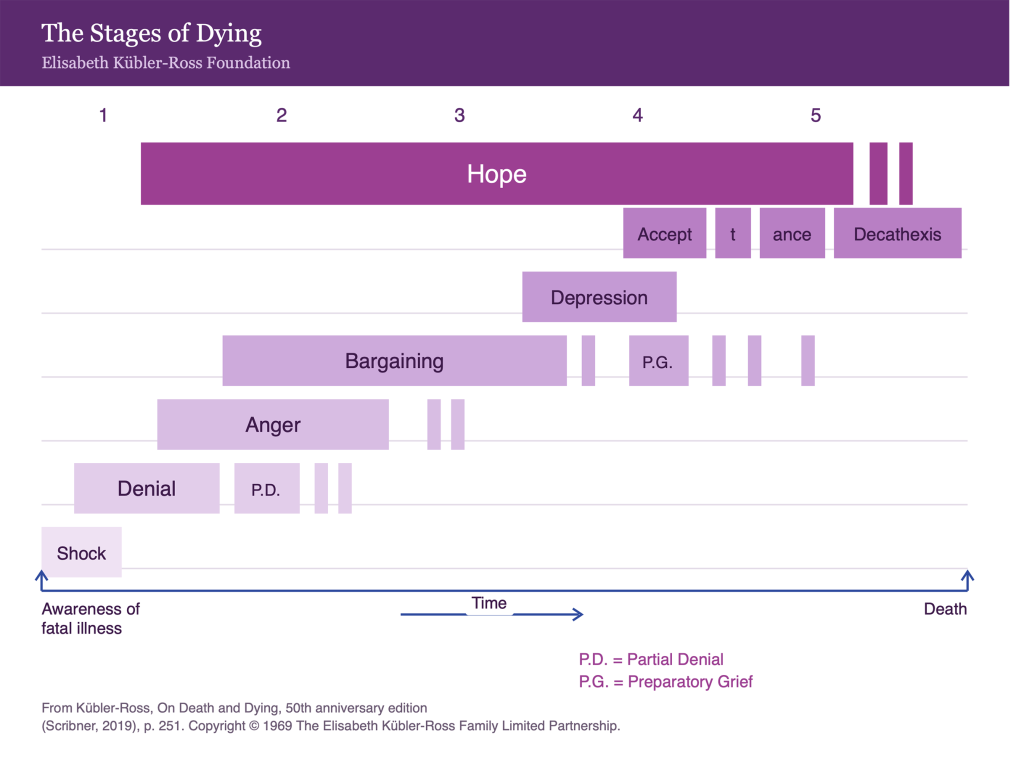
The other responses come and go. They overlap, repeat, or never appear at all. Hope was different. It was not a step to reach or a box to pass through. It was the thread woven through every other feeling, holding them together.
The kinds of hope she saw
In the Hope chapter, Elisabeth described what she heard from dying patients again and again: that no matter how much they had accepted, they kept some hope alive.
Hope for a way out
A new drug, a research breakthrough, a last-minute rescue. Even patients who had come to terms with dying often held on to this possibility, and it helped them endure.
Hope that changes shape
Hope did not vanish as death came closer. It changed what it was hoping for. In her lectures she spoke not of one hope but of many.
Hope held by others
She saw the pain it caused when doctors or family gave up hope while the patient still needed it, and also when a family could not let go of hope after the patient was ready.
She also observed that when a patient stopped expressing hope altogether, it was often a sign that death was near. Hope, for her, was not a mood. It was a sign of life.
Hope stayed while the model changed
Between 1969 and 1978 she revised the stages again and again. Names changed, responses were added and dropped. Hope was the one element that stayed at the center every time.
1969
A full chapter on hope follows the five stages. On the chart, hope is unnumbered and runs the whole length.
On Death and Dying
1973
In her recorded lectures she speaks of many hopes, and relabels stages with names like "Pseudo-Denial" and "Acceptance or Resignation."
Coping With Death & Dying, cassette album
1974
She applies the stages to other losses. Partial denial is gone from her account. Preparatory grief and hope remain.
Questions and Answers on Death and Dying
1978
No timeline, no order. The stages become overlapping circles, all held inside two rings: hope and dreams.
Circle of Stages and Emotions
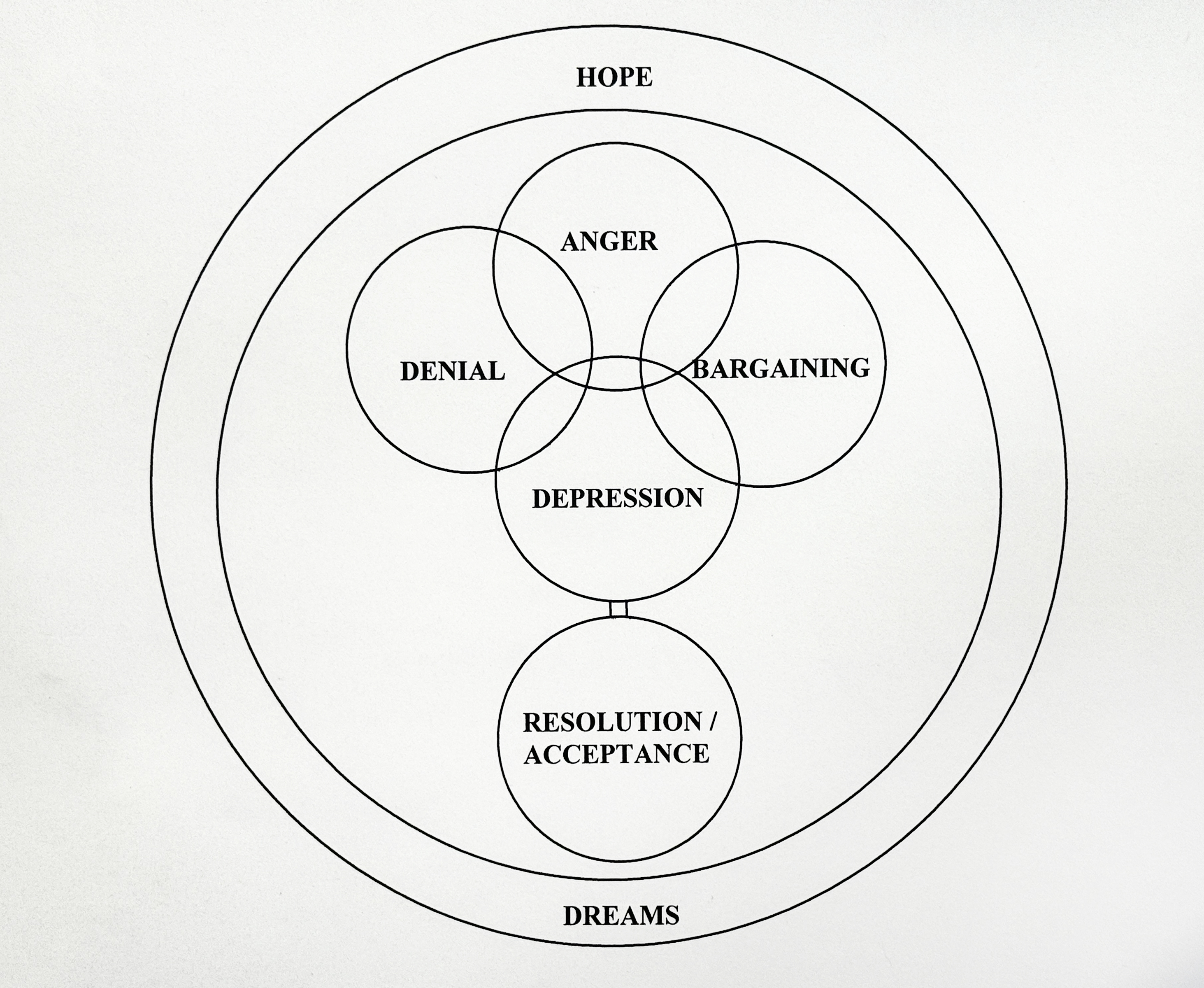
By 1978, hope was no longer even a band beside the others. It had become the space that contained them all.
A liminal space
Anthropologists use the term liminal space, from the Latin limen, "threshold," for the in-between place where one way of being has ended and the next has not yet begun. The idea comes from Arnold van Gennep's study of rites of passage (1909) and was developed by Victor Turner, who described people in that state as "betwixt and between." Today many chaplains, hospice workers and grief writers speak of grief itself as a liminal space.
It is a helpful way to understand what hope meant to Elisabeth. Hope lives in the thresholds: between the diagnosis and the ending, between denial and anger, between what was lost and what may still come. It is the thread a person can hold onto while standing in the in-between.
Elisabeth did not use the word "liminal" herself. It is the Foundation's way of describing what her own charts and writing show.
Not false hope
Hope is sometimes misread as denial, or as false optimism that keeps people from facing the truth. That is not what Elisabeth described. She believed patients should be told the truth about their illness, and that no one should take away a person's hope. Hope and honesty were never opposites in her work. Hope was what allowed people to bear the truth.
What this means if you are grieving
- You can grieve and hope at the same time. One does not cancel the other.
- Your hopes may change: from hope for recovery, to hope for time, to hope for peace, to hope for how you will carry this love forward. That is not giving up. It is hope finding its next shape.
- Feeling "in between," no longer who you were and not yet who you will be, is a normal part of loss. It is a threshold, not a failure.
- If you are supporting someone who is dying or grieving, you do not need to protect them from the truth, or take away their hope. Stay beside them in the in-between.
Grief lives in the in-between places. Hope is the thread that runs through them.
Sources: On Death and Dying, 50th anniversary edition (Scribner, 2019), chapter "Hope" and chart p. 251 · Coping With Death and Dying, cassette album (1973) · Questions and Answers on Death and Dying (1974) · Circle of Stages and Emotions (1978), family collection · Arnold van Gennep, Les Rites de Passage (1909) · Victor Turner, "Betwixt and Between: The Liminal Period in Rites de Passage" (1967)
If you are grieving and need support now, visit our If You Are Grieving page.