

Dr. Elisabeth Kübler-Ross: A Legacy of Compassion, Courage and Transformation
Elisabeth Kübler-Ross was born on July 8, 1926, in Zurich, Switzerland, one of triplet sisters. Fiercely independent from childhood, she set her sights on medicine against her father’s wishes and entered the University of Zurich, where she met her future husband, the American medical student Emanuel “Manny” Ross.
Her calling took shape in the aftermath of the Second World War. In 1945, at nineteen, she volunteered with the International Voluntary Service for Peace, helping to rebuild shattered communities in Eastern Europe. At the Majdanek concentration camp in Poland she found butterflies scratched into the walls of the children’s barracks — final messages of hope left in a place of horror. The image stayed with her for the rest of her life, and the butterfly became her symbol of transformation.
She completed her medical degree in 1957 and moved to the United States in 1958, working in hospitals in New York, Colorado and finally Chicago. There she saw how dying patients were left alone — physically and emotionally — by doctors who avoided them, staff who kept their distance and families who did not know what to say. “Nobody was honest with them,” she said, “so I made it my mission to listen.” Sitting with dying patients and letting them speak, often in front of medical students and clergy, became the foundation of everything that followed.
In 1969 she published On Death and Dying, drawn from those interviews. In it she described five responses she had observed in patients facing a terminal diagnosis — denial, anger, bargaining, depression and acceptance. She was clear that these were not a fixed sequence, that not everyone experiences all of them, and that they can overlap and return. Her point was never a formula; it was that dying people have wisdom to share and deserve to be heard. The book became an international bestseller, was featured in Life magazine, and is still taught in medical, nursing and counseling programs around the world. In 1999 the New York Public Library named it one of its Books of the Century.
The “five stages” later took on a life of their own, applied to grief of every kind and often reduced to a checklist she never intended. In her last book, On Grief and Grieving (2005, with David Kessler), she wrote that the stages “were never meant to help tuck messy emotions into neat packages.” The Elisabeth Kübler-Ross Foundation presents her work in that spirit — as an invitation to listen, not a map to follow.
Her influence was rapid and far-reaching. In 1972 she testified before the United States Senate on the treatment of the dying in American hospitals, a rare platform for a foreign-born woman physician, and her testimony helped open the way for the hospice and palliative care movements in the United States. Through the 1970s she lectured to audiences of thousands every week, sharing platforms with figures such as Ram Dass and the grief researcher Dr. William Worden, and helped move the public conversation about death from a clinical event to a human one.
She worked alongside Dr. Balfour Mount, the founder of palliative care in North America, whose unit at Montreal’s Royal Victoria Hospital drew on her teaching. She championed hospice care for children when the idea was still taboo, making the first donation to Children’s Hospice International, founded by Ann Armstrong-Dailey. And beginning in 1984, at Vacaville, California, and later in Ireland and Scotland, she brought hospice care into prisons — work that laid the groundwork for prison hospice programs today.
In 1977 she founded Shanti Nilaya (“home of peace”) in Escondido, California, a retreat and teaching center, and from there her Life, Death and Transition workshops, which continue to this day. In 1985 she moved to a farm in Head Waters, Virginia, which she named Healing Waters, intending to open a hospice for babies with AIDS abandoned by their families. The plan met fierce local opposition, and in 1994 her home was burned to the ground in an arson attack. She lost her archives, her writings and nearly everything she owned. A series of strokes followed, leaving her partially paralyzed.
She spent her last years in Scottsdale, Arizona, near her son Ken. The strokes left her partly paralyzed, and she was frank about how hard that was. But her own letters from those years tell a different story from the one often repeated. In 1998 she completed her fourth 10-kilometer benefit walkathon in Phoenix, in her wheelchair, and gave her first public talks in four years. She fed some 200 birds and 14 coyotes outside her living-room window, and joked that her water therapy let her walk in water, “if not on water.” Comparing herself with patients far sicker than she was, she called herself lucky. She finished Life Lessons with David Kessler, her first book, she said, about life rather than death. In 2001 she flew to Maine to accept a lifetime achievement award for her hospice work, and Meilen, the lakeside town where she grew up, made her an honorary citizen. She continued to write, teach and receive visitors, among them Muhammad Ali, Oprah Winfrey, Susan Sarandon and Shirley MacLaine. Her letters from these years are collected in the Foundation’s Newsletters Archive.
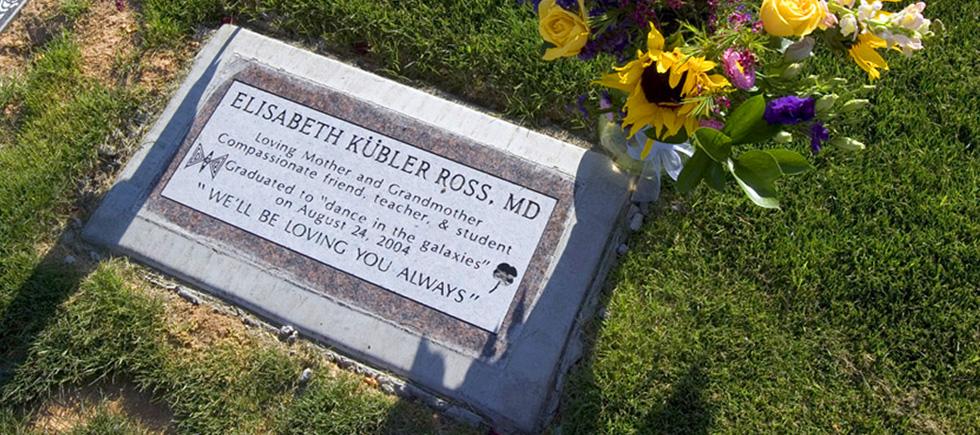
She died on August 24, 2004, at the age of 78. Elisabeth Kübler-Ross wrote 24 books, published in 44 languages, including Questions and Answers on Death and Dying, On Children and Death, The Wheel of Life and Life Lessons (with David Kessler). She received 19 honorary degrees, was a founding member of the American Holistic Medical Association, co-founded the International Work Group on Death, Dying and Bereavement, and was named Ladies’ Home Journal Woman of the Decade in 1979. In 1999 TIME magazine profiled her as one of the “unsung heroes” of twentieth-century science and medicine in its TIME 100 Scientists and Thinkers issue. She was inducted into the National Women’s Hall of Fame in 2007.
Her ideas have traveled far beyond medicine. The Kübler-Ross Change Curve®, adapted from her work, is used by organizations worldwide to help people through change. The five stages have become part of everyday language, from television and literature to more than 200 recording artists who have named albums, songs, and bands after them, usually in the short, ordered form she spent years qualifying. That reach is one reason the Foundation works to present the stages as she actually wrote them.
2026 marks the centennial of her birth. To mark it, the Elisabeth Kübler-Ross Foundation is bringing her original teachings to new audiences: a restored and updated edition of On Death and Dying, her archival lectures and interviews made available in English, German and Spanish, new education programs developed with partner organizations in hospice and end-of-life care, and the continued work of the Foundation’s international chapters — from a hospice under construction in the villages of eastern Guatemala to pediatric hospice in Chile.
She taught that death is not the enemy but a teacher, and that the way we care for the dying is the measure of how we care for one another. The butterfly she carried from Majdanek remains the Foundation’s symbol: in death, as in life, there is transformation, meaning and hope.