

Dr. Elisabeth Kübler-Ross: A Legacy of Compassion, Courage and Transformation
Elisabeth Kübler-Ross was born on julio 8, 1926, in Zurich, Switzerland, one of triplet sisters. Fiercely independent from childhood, she set her sights on medicine against her father’s wishes and entered the University of Zurich, where she met her future husband, the American medical student Emanuel “Manny” Ross.
Su vocación cobró forma tras la Segunda Guerra Mundial. En 1945, con diecinueve años, se alistó como voluntaria en el Servicio Internacional de Voluntarios por la Paz, ayudando a reconstruir comunidades devastadas en Europa del Este. En el campo de concentración de Majdanek, en Polonia, encontró mariposas grabadas en las paredes de los barracones de los niños: últimos mensajes de esperanza dejados en un lugar de horror. Esa imagen la acompañó durante el resto de su vida, y la mariposa se convirtió en su símbolo de transformación.
Se licenció en Medicina en 1957 y se trasladó a Estados Unidos en 1958, donde trabajó en hospitales de Nueva York, Colorado y, finalmente, Chicago. Allí fue testigo de cómo los pacientes terminales se quedaban solos —tanto física como emocionalmente—: los médicos los evitaban, el personal se mantenía a distancia y las familias no sabían qué decirles. «Nadie era sincero con ellos», dijo, «así que me propuse como misión escucharles». Sentarse junto a los pacientes terminales y dejarles hablar, a menudo ante estudiantes de medicina y clérigos, se convirtió en la base de todo lo que vino después.
In 1969 she published On Death and Dying, drawn from those interviews. In it she described five responses she had observed in patients facing a terminal diagnosis — denial, anger, bargaining, depression and acceptance. She was clear that these were not a fixed sequence, that not everyone experiences all of them, and that they can overlap and return. Her point was never a formula; it was that dying people have wisdom to share and deserve to be heard. The book became an international bestseller, was featured in Life magazine, and is still taught in medical, nursing and counseling programs around the world. In 1999 the New York Public Library named it one of its Books of the Century.
The “five stages” later took on a life of their own, applied to grief of every kind and often reduced to a checklist she never intended. In her last book, On Grief and Grieving (2005, with David Kessler), she wrote that the stages “were never meant to help tuck messy emotions into neat packages.” The Elisabeth Kübler-Ross Foundation presents her work in that spirit — as an invitation to listen, not a map to follow.
Su influencia fue rápida y de gran alcance. En 1972 testificó ante el Senado de los Estados Unidos sobre el trato que recibían los moribundos en los hospitales estadounidenses, una tribuna poco habitual para una médica nacida en el extranjero, y su testimonio ayudó a allanar el camino para los movimientos a favor de los cuidados paliativos y los centros de cuidados terminales en los Estados Unidos. A lo largo de la década de 1970, impartió conferencias ante miles de personas cada semana, compartiendo escenario con figuras como Ram Dass y el investigador sobre el duelo, el Dr. William Worden, y contribuyó a que el debate público sobre la muerte pasara de considerarse un hecho clínico a uno humano.
Trabajó junto al Dr. Balfour Mount, fundador de los cuidados paliativos en Norteamérica, cuya unidad en el Hospital Royal Victoria de Montreal se inspiró en sus enseñanzas. Defendió los cuidados paliativos para niños cuando la idea aún era un tabú, realizando la primera donación a Children’s Hospice International, fundada por Ann Armstrong-Dailey. Y a partir de 1984, en Vacaville (California), y más tarde en Irlanda y Escocia, llevó los cuidados paliativos a las prisiones, una labor que sentó las bases de los programas de cuidados paliativos en prisiones actuales.
En 1977 fundó Shanti Nilaya («hogar de la paz») en Escondido, California, un centro de retiro y formación, y desde allí impartió sus talleres sobre «Vida, muerte y transición», que continúan hasta hoy. En 1985 se trasladó a una granja en Head Waters, Virginia, a la que llamó «Healing Waters», con la intención de abrir un centro de cuidados paliativos para bebés con sida abandonados por sus familias. El plan se topó con una feroz oposición local y, en 1994, su casa quedó reducida a cenizas en un incendio provocado. Perdió sus archivos, sus escritos y casi todo lo que poseía. A continuación sufrió una serie de accidentes cerebrovasculares que la dejaron parcialmente paralizada.
She spent her last years in Scottsdale, Arizona, near her son Ken. The strokes left her partly paralyzed, and she was frank about how hard that was. But her own letters from those years tell a different story from the one often repeated. In 1998 she completed her fourth 10-kilometer benefit walkathon in Phoenix, in her wheelchair, and gave her first public talks in four years. She fed some 200 birds and 14 coyotes outside her living-room window, and joked that her water therapy let her walk in water, “if not on water.” Comparing herself with patients far sicker than she was, she called herself lucky. She finished Life Lessons with David Kessler, her first book, she said, about life rather than death. In 2001 she flew to Maine to accept a lifetime achievement award for her hospice work, and Meilen, the lakeside town where she grew up, made her an honorary citizen. She continued to write, teach and receive visitors, among them Muhammad Ali, Oprah Winfrey, Susan Sarandon and Shirley MacLaine. Her letters from these years are collected in the Foundation’s Newsletters Archive.
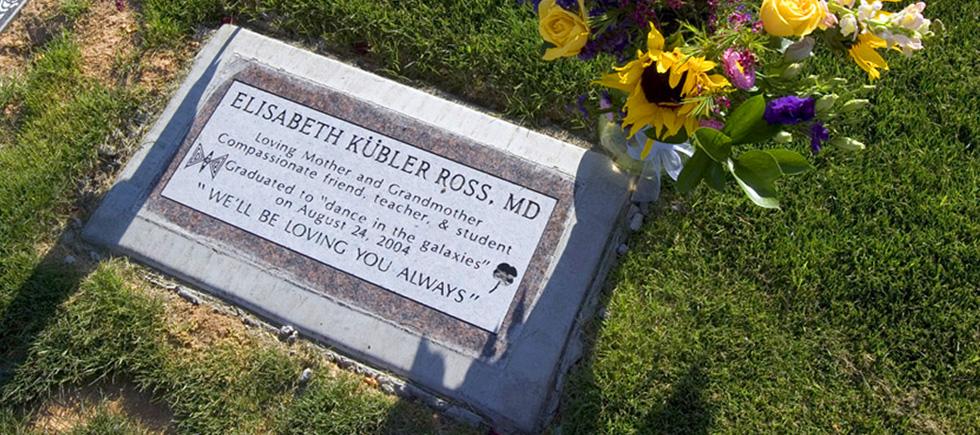
She died on Agosto 24, 2004, at the age of 78. Elisabeth Kübler-Ross wrote 24 books, published in 44 languages, including Questions and Answers on Death and Dying, On Children and Death, The Wheel of Life and Life Lessons (with David Kessler). She received 19 honorary degrees, was a founding member of the American Holistic Medical Association, co-founded the International Work Group on Death, Dying and Bereavement, and was named Ladies’ Home Journal Woman of the Decade in 1979. In 1999 TIME magazine profiled her as one of the “unsung heroes” of twentieth-century science and medicine in its TIME 100 Scientists and Thinkers issue. She was inducted into the National Women’s Hall of Fame in 2007.
Her ideas have traveled far beyond medicine. The Kübler-Ross Change Curve®, adapted from her work, is used by organizations worldwide to help people through change. The five stages have become part of everyday language, from television and literature to more than 200 recording artists who have named albums, songs, and bands after them, usually in the short, ordered form she spent years qualifying. That reach is one reason the Foundation works to present the stages as she actually wrote them.
2026 marks the centennial of her birth. To mark it, the Elisabeth Kübler-Ross Foundation is bringing her original teachings to new audiences: a restored and updated edition of On Death and Dying, her archival lectures and interviews made available in English, German and Spanish, new education programs developed with partner organizations in hospice and end-of-life care, and the continued work of the Foundation’s international chapters — from a hospice under construction in the villages of eastern Guatemala to pediatric hospice in Chile.
Enseñó que la muerte no es el enemigo, sino una maestra, y que la forma en que cuidamos a los moribundos es la medida de cómo nos cuidamos unos a otros. La mariposa que trajo de Majdanek sigue siendo el símbolo de la Fundación: en la muerte, al igual que en la vida, hay transformación, sentido y esperanza.